Grand Egyptian Museum: The Complete Visitor Guide 2026
The Grand Egyptian Museum is the kind of place that changes what you think a museum can be. I have been several times since it opened in November 2025, and every visit reveals something I missed before. That is partly because the building itself is staggering in scale, and partly because housing over 100,000 artifacts in one place means you simply cannot absorb it all in a single day.
The Grand Egyptian Museum is located on the Giza Plateau, approximately 2 kilometers from the Great Pyramids. The museum houses over 100,000 artifacts, including the complete Tutankhamun collection of 5,398 objects displayed together for the first time. It is the largest archaeological museum in the world dedicated to a single civilization, covering 500,000 square meters of total area with 81,000 square meters of exhibition floor space.
If you are planning a trip to Egypt in 2026, the GEM is not optional. It is the reason to come. This guide covers everything you need to know to plan your visit properly.
Why the Grand Egyptian Museum Exists
Egypt needed a new home for its antiquities. The old Egyptian Museum in Tahrir Square, built in 1902, was overcrowded, underfunded, and running out of room. Artifacts sat in storage for decades because there was nowhere to display them. The Tutankhamun collection alone had never been shown in full. Pieces were scattered across different institutions or locked in basement vaults.
The idea for the GEM was born in 1992. Construction began in 2005. The project took twenty years and cost $1.2 billion, with roughly 75 percent funded through low-interest loans from Japan's International Cooperation Agency (JICA). The Egyptian government covered the rest.
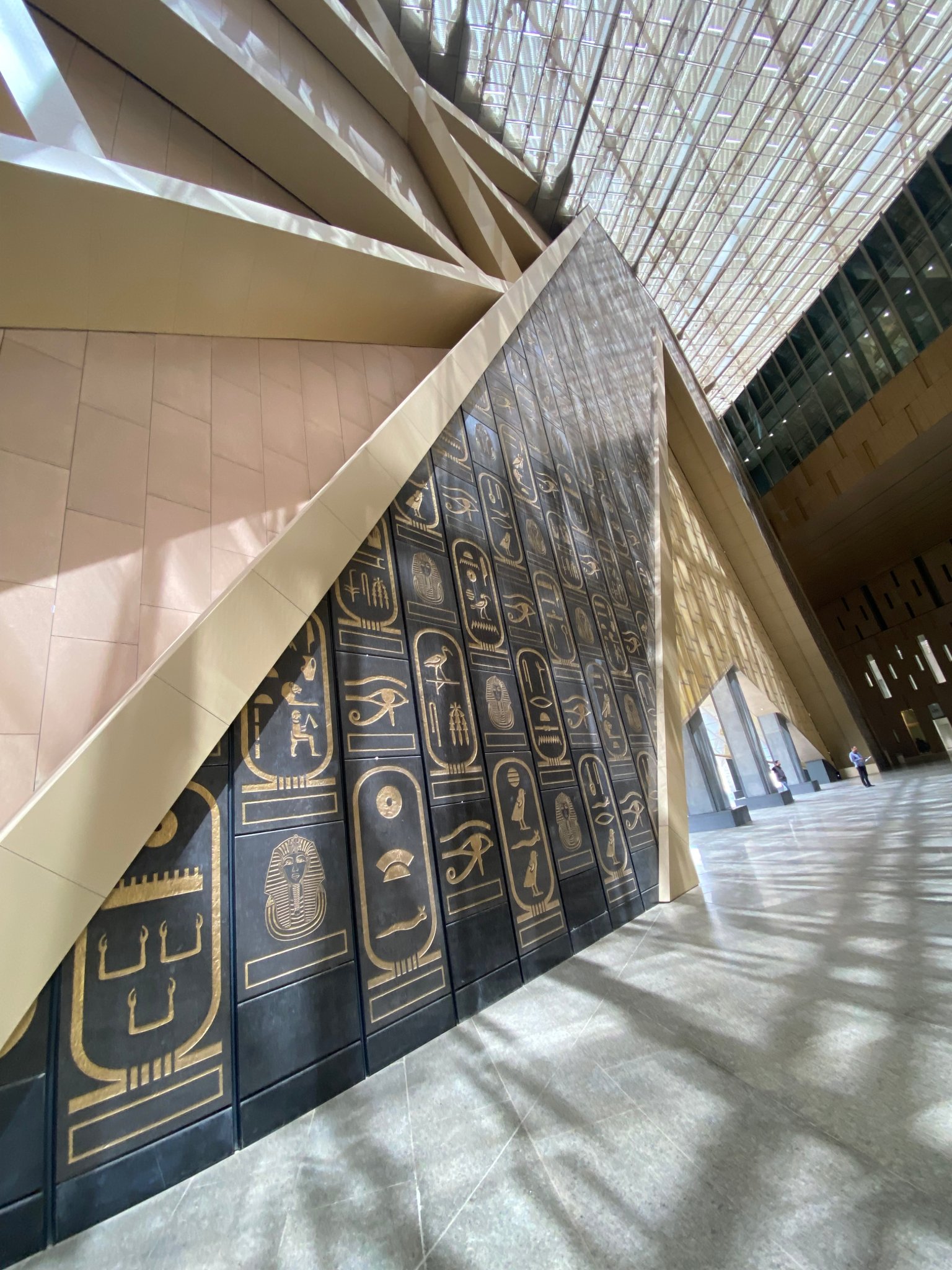
The result is a triangular modernist structure that sits at the edge of the Giza Plateau, its massive glass facade framing a direct sightline to the Pyramids. The architecture alone is worth the visit. Huge glass walls flood the interior with natural light, making the ancient statues and stone carvings look alive in a way the old museum never managed.
The museum officially opened to the public on November 1, 2025, with all twelve permanent exhibition halls accessible. It was worth the wait.
How to Get to the Grand Egyptian Museum
The GEM sits on the western edge of Cairo, in Giza, along the Cairo-Alexandria Desert Road. It is not in the city center, so plan your transport accordingly.
From Downtown Cairo
The drive from downtown Cairo to the museum takes roughly 30 to 45 minutes depending on traffic. Cairo traffic is exactly as chaotic as its reputation suggests, so give yourself buffer time, especially during morning and evening rush hours.
Your best option is Uber or Careem (the regional rideshare app). A ride from downtown Cairo costs roughly 150 to 250 EGP, which works out to about $3 to $5 USD. Both apps are widely used, reliable, and remove the need to negotiate with taxi drivers.
If you prefer the metro, take Line 2 to either the Faisal or Cairo University station, then grab a short taxi or Uber to the museum from there. The metro itself is cheap (a few EGP per ride) and reasonably efficient, though it gets extremely crowded during peak hours.
There is no direct metro station at the museum yet. A dedicated line is under construction, but it is not operational in 2026.
From Cairo International Airport
The airport is on the opposite side of Cairo from Giza. Expect a 45- to 75-minute drive depending on traffic, covering roughly 40 kilometers. Uber from the airport to the GEM costs around 300 to 500 EGP ($6 to $10 USD). Many hotels also arrange airport transfers, and if you are booking a private tour of the museum, most operators include hotel pickup.
If you are arriving on an international flight and heading straight to the museum, I would not recommend it. Check in first, rest, and visit the next day with fresh eyes. You will want your full energy for this one.
From Other Egyptian Cities
If you are coming from Luxor, Aswan, or Alexandria, you have two practical options: a domestic flight into Cairo International, or the train. EgyptAir runs frequent domestic flights, and the overnight sleeper train from Luxor and Aswan arrives at Giza Station, which is closer to the museum than Cairo's main Ramses Station.
Grand Egyptian Museum Tickets: Prices, Types, and How to Book
One important rule: the Grand Egyptian Museum does not sell tickets at the door. All tickets must be booked online in advance through the official portal at visit-gem.com. This is not optional. If you show up without a ticket, you will not get in.
Current Ticket Prices (May 2026)
For foreign visitors, the standard adult admission is 1,450 EGP (approximately $29 to $30 USD). Students aged 13 to 25 with a valid student ID and children aged 6 to 12 pay 730 EGP (approximately $15 USD). Children under 6 enter free.
Egyptian nationals pay 200 EGP for adults and 100 EGP for students, children, and seniors.
Note that ticket prices are scheduled to increase in November 2026. Foreign adult tickets will rise to approximately $35 USD, and Egyptian adult tickets to 220 EGP. If you are visiting before November, you are getting the lower rate.
How Booking Works
When you book online, you must select a specific entry time slot. The museum runs eight time slots per day, and each slot has a visitor cap. This system exists to manage crowd flow and prevent the kind of overwhelming overcrowding that plagued the old museum.
Book your slot at least a few days in advance, especially during peak season (October through March) and on weekends. Friday and Saturday are the busiest days. If your preferred slot is full, the museum sometimes allows entry one to two hours after your booked time, but do not count on this.
VIP and Private Tour Options
Several licensed tour operators offer VIP packages that include skip-the-line access, a private Egyptologist guide, and sometimes after-hours or restricted-area access. These typically run $150 to $400 USD per person depending on group size and inclusions. Most also include private air-conditioned transportation from your hotel.
If you are spending $3,000 or more on a trip to Egypt, a private guided tour of the GEM is one of the smartest upgrades you can make. The difference between wandering the halls alone and having a knowledgeable Egyptologist walk you through 5,000 years of context is enormous.
Grand Egyptian Museum Opening Hours and Best Times to Visit
Standard Hours
The museum complex opens daily at 8:30 AM, with galleries accessible from 9:00 AM to 6:00 PM. Last entry to the galleries is at 5:00 PM.
On Wednesdays and Saturdays, hours are extended. The complex stays open until 10:00 PM, and galleries remain accessible until 9:00 PM. These extended evenings are worth targeting if you can.
Hours may vary during public holidays, national events, and Ramadan. Check the official site before your visit.
When to Go to Avoid Crowds
Weekday mornings are the sweet spot. Tuesday, Wednesday, and Thursday see the lightest traffic, and booking the first time slot (9:00 AM) gets you into the galleries before the tour groups arrive. Most organized tours start filtering in around 10:00 to 10:30 AM, so that first hour is noticeably calmer.
The extended Wednesday and Saturday evenings are also excellent. The late afternoon crowd thins out around 5:00 PM, and the museum takes on a completely different character in the evening light. The Pyramid views through the glass facade at sunset are reason enough to time your visit this way.
Avoid Friday mornings (the busiest period of the week) and any time during Egyptian school holidays. December and January are peak tourist season and the museum runs near capacity most days.
What to See Inside the Grand Egyptian Museum
The museum spans twelve permanent exhibition halls, organized chronologically from prehistoric Egypt through the Roman period. You cannot see everything in one visit. Accept this now, and you will have a better time.
The Grand Staircase and Ramesses II
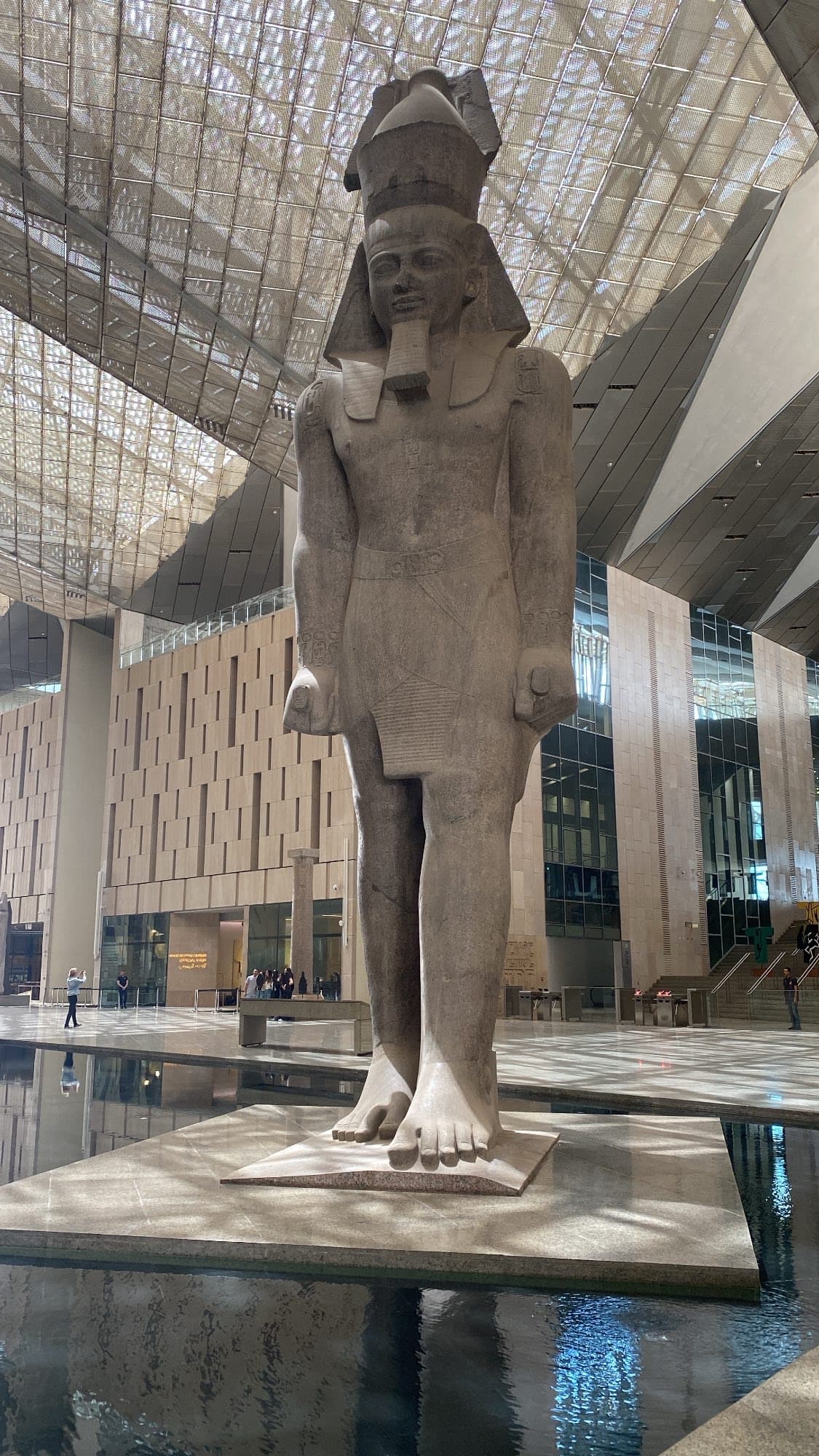
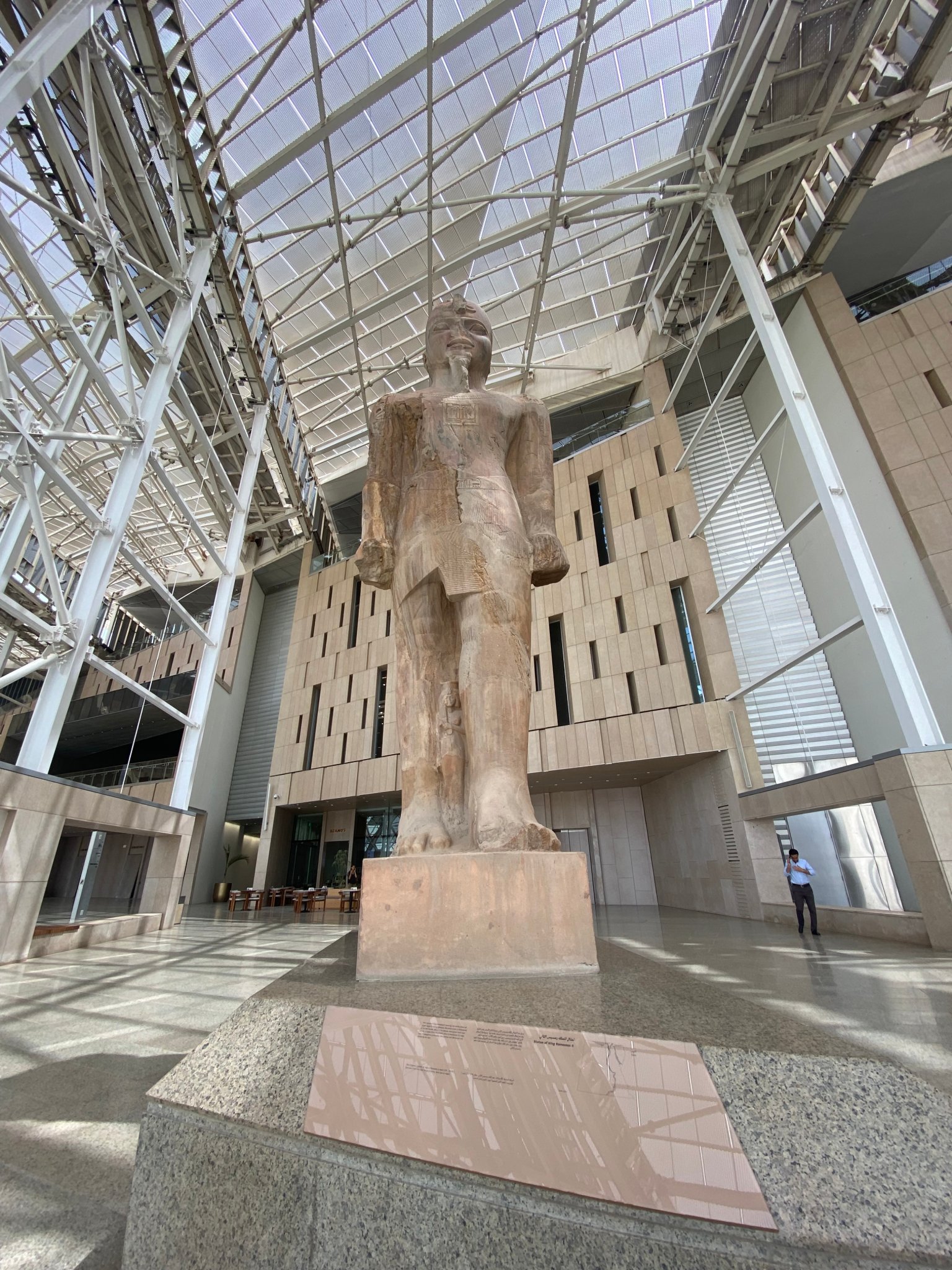
Your visit begins with a statement. The entrance hall features a massive statue of Ramesses II, standing over 11 meters tall and weighing 83 tons. It was transported here from its previous location near the old Ramses Railway Station in Cairo. Behind it, the Grand Staircase rises through the atrium, lined with dozens of monumental statues and artifacts arranged chronologically. Walking up this staircase is one of the most powerful experiences in the museum. You are literally ascending through Egyptian history.
The Tutankhamun Galleries
This is what most people come for, and it delivers. Two full halls are dedicated exclusively to the 5,398 objects recovered from Tutankhamun's tomb by Howard Carter in 1922. For the first time in history, the entire collection is displayed together in one place.
The famous golden death mask is here, of course. But so are thousands of objects most people have never seen: golden beds, ceremonial chariots, jewelry, furniture, clothing, board games, food offerings, and ritual objects. The sarcophagus and nested coffins are extraordinarily well preserved, with vivid reds, turquoise, coral, and navy blues still intact. You can still see every etched lotus flower, every phoenix, every line of hieroglyphic text.
One artifact worth seeking out is the celestial dagger. It has been on display before, but never with proper context. Recent analysis confirmed that the blade was forged from meteorite iron, identifiable by its high nickel and cobalt content. A 3,300-year-old knife made from a rock that fell from the sky. That is the kind of detail you only get in this museum.
The exhibition design mixes traditional display cases with interactive digital installations and reconstructed burial chambers. The multimedia storytelling adds genuine depth without feeling gimmicky.
The Khufu Boat
A separate building at the rear of the museum complex houses the Solar Boat of Khufu, a 42-meter-long wooden vessel discovered in 1954 at the foot of the Great Pyramid. The boat is remarkably intact for something built 4,500 years ago and offers a window into ancient Egyptian craftsmanship and their beliefs about the afterlife.
Other Highlights Worth Your Time
The Royal Mummies hall, if accessible during your visit, is a solemn and remarkable experience. The pre-dynastic collection shows just how far back Egyptian civilization reaches. The jewelry halls contain pieces of astonishing technical skill from goldsmiths working thousands of years before modern tools existed. The Amarna period galleries covering the reign of Akhenaten and Nefertiti are fascinating for anyone interested in how power and religion intersected in ancient Egypt.
The stone sculpture halls on the upper levels are often less crowded and contain extraordinary pieces that most visitors skip because they have run out of energy by that point. If you pace yourself, these rooms reward the effort.
How Much Time Do You Actually Need
I will be honest: most people underestimate this. The museum is enormous, and if you try to rush through it in two hours, you will leave feeling overwhelmed and unsatisfied.
For a meaningful visit covering the highlights, plan for four to five hours minimum. If you want to see the Tutankhamun galleries thoroughly, explore the major exhibition halls, spend time with the Khufu Boat, and have a meal, six hours is realistic. Serious history enthusiasts could spend two full days and still not see everything.
My recommendation for a first visit: arrive at opening, spend the morning in the Tutankhamun galleries before they get crowded, break for lunch, then explore the other halls at a relaxed pace through the afternoon. If you are visiting on a Wednesday or Saturday, the extended evening hours give you breathing room.
If you are comparing visiting independently versus with a guide versus with a private tour, here is the honest breakdown. Going alone is fine if you are a confident self-directed traveler and comfortable reading signage (which is in Arabic and English). An audio guide adds context and costs little. A guided group tour gives you structure and an Egyptologist's knowledge but locks you into someone else's schedule. A private tour is the best experience by a wide margin because your guide adapts to your interests, you skip lines, and you control the pace. It costs more. It is worth it.
How to Get Private Access to the Grand Egyptian Museum
Private access to the GEM goes beyond a standard skip-the-line ticket. Several licensed operators offer experiences that include an Egyptologist guide dedicated to your group, priority entry, and access to restricted sections or special exhibitions when available.
The best private tours come from operators who employ actual Egyptologists, not just licensed tour guides who memorized a script. Ask specifically about your guide's qualifications before booking. The depth of knowledge between a trained Egyptologist and a general tour guide is the difference between reading a Wikipedia article and attending a university lecture.
Most luxury private tours include hotel pickup in an air-conditioned vehicle, all entrance fees, a dedicated guide for three to five hours inside the museum, and bottled water. Prices range from $150 to $400 per person depending on group size and the level of access included.
Some operators also offer combined packages: the GEM in the morning and the Pyramids in the afternoon, or vice versa. Given the proximity of the two sites (about 2 kilometers apart), this makes logistical sense. A full day combining both is one of the best things to do in Cairo.
Nearby Attractions: The Pyramids and Beyond
The Grand Egyptian Museum's location is not accidental. It sits on the Giza Plateau, a short drive from the Pyramids of Giza, the Great Sphinx, and the surrounding archaeological sites.
The Pyramids of Giza
The Great Pyramid of Khufu, the Pyramid of Khafre, and the Pyramid of Menkaure are approximately 2 kilometers from the museum entrance. A pedestrian walkway connecting the museum directly to the Pyramid complex is planned but not yet complete in 2026, so you will need to drive or take a short taxi ride between the two.
Combining the museum and the Pyramids in a single day is doable but ambitious. If you are doing both, I suggest starting at the Pyramids early in the morning when the light is best and the heat is manageable, then heading to the air-conditioned museum for the afternoon.
The Great Sphinx
The Sphinx sits at the eastern edge of the Giza Plateau, near the Valley Temple of Khafre. It is included in the Pyramids complex ticket and is worth seeing in person, even though it is smaller than most people expect from photographs.
Sound and Light Show
The Pyramids Sound and Light Show runs most evenings and projects colored lights and narrated history onto the Pyramids and Sphinx. It is touristy, but if you are visiting on a Wednesday or Saturday and using the museum's extended evening hours, you could catch the show after the museum closes. Check the current schedule as show times shift seasonally.
Practical Tips for Your Grand Egyptian Museum Visit
What to Wear
Dress modestly: cover your shoulders and knees. This is not a strict religious requirement at the museum, but it is respectful in Egyptian culture and will make your experience more comfortable.
The most common mistake visitors make is underdressing for the air conditioning inside the galleries. The museum maintains conservation-grade temperatures year-round, which means even when Cairo is 40 degrees Celsius outside in August, the interior can feel cool. Bring a light layer, a scarf or a cardigan, something you can throw on inside the galleries and take off when you step back outside.
Wear comfortable walking shoes. You will cover a lot of ground on polished floors.
Photography Rules
Personal photography and video are allowed throughout most of the museum. Flash photography is prohibited. Tripods, monopods, selfie sticks, drones, and external lighting equipment are not permitted. Some areas, particularly the Royal Mummies hall and certain special exhibitions, may have additional photography restrictions or require a separate permit.
Commercial photography or videography (for media, advertising, or documentary purposes) requires prior written approval from the museum and incurs separate fees.
Food and Drink Inside the Museum
The GEM has a genuinely good food and beverage scene, which is unusual for a museum. You are not stuck with vending machines and sad sandwiches.
Zooba serves elevated Egyptian street food: koshary, shawarma, falafel, and other classics. It is designed like a series of market stalls and feels more like a Cairo street corner than a museum cafeteria. The fine dining restaurant on the upper level offers contemporary cuisine with views directly overlooking the Pyramids, which is a hard setting to beat. 30 North works well for coffee and a lighter break. Beano's and Ratio's Bakery cover the cafe category. There is even a Starbucks if that is your thing, and Mandarine Koueider for traditional Egyptian sweets.
All dining spots accept credit cards and operate during museum hours.
Bags and Belongings
Bags up to 40 x 40 cm (roughly 16 x 16 inches) are allowed inside the galleries. Anything larger must be checked at the cloakroom near the entrance. Bring a power bank for your phone since you will be taking a lot of photos and six hours of screen use drains a battery fast.
Accessibility
The museum is modern and purpose-built, so accessibility is significantly better than at older Egyptian sites. Ramps, elevators, and accessible restrooms are available throughout the complex.
Helpful Arabic Phrases
You do not need Arabic to visit the museum. All signage is bilingual (Arabic and English), and staff at the ticket counters and information desks speak English. But a few words go a long way in Egypt:
"Shukran" means thank you. "Min fadlak" (to a man) or "min fadlik" (to a woman) means please or excuse me. "Bekam?" means how much. "El hammam fein?" means where is the bathroom. Egyptians genuinely appreciate any effort to speak Arabic, even badly. You will get warmer responses and better service.
The Museum Shop
The GEM gift shop is better than most museum shops you have visited. It stocks a curated selection of items, many made exclusively for the museum using traditional Egyptian techniques and locally sourced materials.
The jewelry from Okhtein, an Egyptian luxury brand, blends ancient motifs with contemporary design and is genuinely beautiful. Kahhal Looms sells handmade rugs from a collection called "Weaving Eternity" that draws on ancient Egyptian symbols. The body care line uses natural Egyptian ingredients. The book selection is excellent and reasonably priced, including coffee table books about the museum's collection that you will not find anywhere else.
If you are looking for a meaningful souvenir rather than a plastic Sphinx, this is where to buy it. Budget twenty to thirty minutes here. It is worth browsing.
How the Grand Egyptian Museum Fits Into a Broader Egypt Itinerary
Egypt is not a one-city destination. The GEM is the anchor of any Cairo visit, but the country's real depth unfolds when you move south along the Nile.
A strong two-week Egypt itinerary might look like this: two to three days in Cairo and Giza (the GEM, the Pyramids, Old Cairo, Khan el-Khalili), then fly or train to Luxor for the Valley of the Kings, Karnak Temple, and the West Bank. From Luxor, a Nile cruise to Aswan covers Edfu, Kom Ombo, and the temples along the river. Aswan itself offers Philae Temple, the Nubian villages, and the option to visit Abu Simbel.
If your itinerary includes the Suez Canal, you are seeing a different side of Egypt entirely: the intersection of modern engineering and ancient trade routes, a waterway that changed global commerce, and a coastline that most tourists never reach.
For anyone wondering is Egypt safe for luxury travel, the short answer is yes. The tourist infrastructure has improved dramatically in recent years, and the GEM itself is a testament to Egypt's investment in welcoming international visitors at the highest standard.
How Ancient Reset Guests Experience the Grand Egyptian Museum
At Ancient Reset, a luxury wellness retreat near the Grand Egyptian Museum, private museum access is built into the 7-day retreat program. Guests visit the GEM with a dedicated Egyptologist guide, outside of peak hours, with no tour group schedule to follow. You move at your own pace. You ask the questions you actually want answered. You spend forty-five minutes with the Tutankhamun collection if that is what moves you, or you linger in the sculpture halls that most visitors walk past.
It is a different way to experience a museum. Not rushed, not performative, not checking a box on a sightseeing list. Just you and 5,000 years of history, with someone who has spent their career studying it standing next to you.
If the Grand Egyptian Museum is on your list, Ancient Reset includes private museum access as part of the 7-day retreat. No tour groups, no rushing. Just you and 5,000 years of history. Book your week.