Is Egypt Safe to Travel? An Honest 2026 Assessment
If you are reading this, you are probably doing what every thoughtful traveler does before booking a trip to Egypt: searching for a straight answer about safety.
I understand the instinct. I had the same conversation with myself, from the opposite direction. I am Egyptian-born. I spent years living and working abroad in tech. When I decided to come back and build a wellness retreat on the Suez Canal, the first question everyone asked, politely or not, was some version of "Is that safe?"
It is a fair question. Egypt carries a specific kind of baggage in the Western imagination. Cable news footage from 2011 and 2013 still plays on a loop in people's heads. The Sinai insurgency, now largely contained, shaped a decade of travel advisories. And the sheer unfamiliarity of the region makes it easy to lump all of North Africa and the Middle East into a single risk category.
None of that is a reason to dismiss the question. It is a reason to answer it properly, with data rather than defensiveness. That is what this post attempts to do. I talk to prospective travelers about this exact concern on a regular basis, and I have found that the honest answer, the one grounded in current evidence, is more reassuring than any amount of hand-waving.
So here is what the picture actually looks like in 2026.
What the Data Actually Says
Start with the official government advisories, since they set the baseline for most travelers' risk assessments.
The U.S. State Department rates Egypt at Level 2: Exercise Increased Caution, as of its July 2025 update. That is the same level assigned to the United Kingdom, France, Germany, Italy, Spain, and dozens of other countries that millions of tourists visit without a second thought. The advisory cites general terrorism risk and petty crime. It places "Do Not Travel" designations only on Northern Sinai and parts of the Western Desert, areas far removed from any tourist corridor.
The UK Foreign, Commonwealth and Development Office (FCDO) advises against all travel to North Sinai and within 20km of the Libya border. For the rest of the country, including Cairo, Luxor, Aswan, Hurghada, and the Nile Valley, the advice is standard travel with normal precautions.
Canada advises travelers to "exercise a high degree of caution," citing regional tensions and terrorism risk. Australia's Smartraveller issues a similar "exercise a high degree of caution" rating.
Now look at what travelers are actually doing. Egypt welcomed a record 19 million international tourists in 2025, a 21% increase year-over-year and well above the global average growth rate of roughly 5%. The World Travel and Tourism Council reported that the sector contributed 8.5% of Egypt's GDP in 2024, employing 2.9 million people. Tourism officials project a further 5 to 7% increase in visitor numbers for 2026.
Nineteen million people visited last year. The vast majority returned home with nothing worse than a sunburn and a stronger opinion about falafel.
Is Egypt Safe for Tourists in 2026?
The short answer: yes, in the areas where tourists actually go. The longer answer requires a bit of geography.
Egypt is a large country, and not all of it carries the same risk profile. The areas that draw tourists, Cairo, the Giza Plateau, Luxor, Aswan, the Red Sea coast, Alexandria, and the Suez Canal cities, have well-established security infrastructure. Tourist police are visible at major sites. Hotels and tour operators in these zones maintain their own security protocols. Violent crime against tourists in these areas is rare.
The areas to avoid are the ones you were not planning to visit anyway. Northern Sinai has been under military operations for years and is off-limits. The far Western Desert near the Libyan border is similarly restricted. No tour operator runs trips to these regions, and no traveler has a reason to go there.
Between those extremes, common-sense travel practices apply. Keep valuables secure. Be aware of your surroundings in crowded areas. Avoid political demonstrations. Use reputable transportation. These are the same things you would do in Rome, Barcelona, or New York.
One pattern I notice in conversations with prospective guests: people conflate regional instability with local conditions. Egypt shares a region with conflict zones, but it is not one. The country has been politically stable since 2014, and its tourism infrastructure has been rebuilt and expanded significantly since 2020.
Is Egypt Safe for Solo Female Travelers?
This is one of the most frequently searched questions about Egypt, and it deserves an honest answer rather than a curated one.
Egypt is a conservative society, and solo female travelers will encounter a different social dynamic than in Western Europe or North America. Street harassment, primarily verbal, is a real issue in Cairo and other large cities. It is not universal, and it has improved in recent years with increased enforcement, but pretending it does not exist would be dishonest.
Here is what shifts the equation. The experience varies significantly by context. Female travelers in organized tours, at established hotels, at archaeological sites, or in resort areas like Hurghada and Sharm el-Sheikh report safety levels comparable to most Mediterranean destinations. The risk is concentrated in specific scenarios: walking alone at night in unfamiliar neighborhoods, using informal transportation, or navigating crowded markets without a local contact.
Practical guidance that experienced solo female travelers to Egypt consistently share: dress modestly in public (this is cultural respect as much as safety), use ride-hailing apps like Uber or Careem rather than street taxis, book accommodations with 24-hour front desks, stay connected with someone who knows your itinerary, and consider hiring a local guide for city exploration.
The women who visit our retreat on the Suez Canal travel within a completely different framework: private transport, a gated residential property, and escorted cultural excursions. But even outside that context, thousands of solo female travelers visit Egypt every year and navigate it successfully. The key is going in with eyes open rather than eyes closed.
How Risk Differs by Travel Style
Here is something that rarely gets discussed in "Is Egypt safe?" articles: your risk profile in Egypt is not fixed. It shifts dramatically depending on how you travel.
A backpacker navigating Cairo's public buses, staying in budget hostels, and improvising day by day has a very different experience than someone on an organized Nile cruise with pre-arranged transportation. And both have a different experience than someone traveling at the luxury end with private vehicles, vetted properties, security-conscious staff, and a concierge handling logistics.
This is not unique to Egypt. The same gradient exists in Brazil, India, Mexico, South Africa, and frankly most countries that attract significant tourism. But it matters more in Egypt because the gap between "budget unstructured" and "premium structured" travel is wider here than in, say, Western Europe.
At the high end, most of the variables that create risk are simply removed. You are not negotiating with unlicensed taxi drivers. You are not figuring out which neighborhoods to avoid at night. You are not relying on public infrastructure for safety. Your property, your transport, and your itinerary have all been vetted.
This is not an argument that only wealthy travelers should visit Egypt. It is an observation that the answer to "is Egypt safe?" genuinely depends on how you plan to move through the country. Budget travel is doable and rewarding, but it requires more preparation, more local knowledge, and more situational awareness. Premium travel compresses that burden significantly.
The Suez Canal Region: A Safety Profile
Most travelers associate Egypt with Cairo and Luxor. The Suez Canal corridor, including the cities of Ismailia, Port Said, and Suez, is less familiar. That unfamiliarity can cut both ways: some travelers assume it must be risky because they have not heard of it; others assume it is calm because it never makes the news.
The second assumption is closer to reality.
Ismailia, where Ancient Reset is located, sits on the western bank of the Suez Canal. It is a residential, family-oriented city that has served as the administrative center for the Suez Canal Authority since the 1860s. The canal is one of the most strategically important waterways on Earth, and the security infrastructure around it reflects that. Canal Authority security operates continuously. The governorate's western bank is a settled, low-crime area with a character closer to a mid-size Egyptian university town than to anything resembling a conflict zone.
One point of transparency: the UK FCDO advises against all but essential travel to parts of Ismailiyah Governorate east of the Suez Canal. This is the eastern bank, closer to the Sinai. The western bank, where Ismailia city and our property sit, is not subject to that restriction. The distinction matters, and I mention it because you should know exactly what the advisories say, not a softened version.
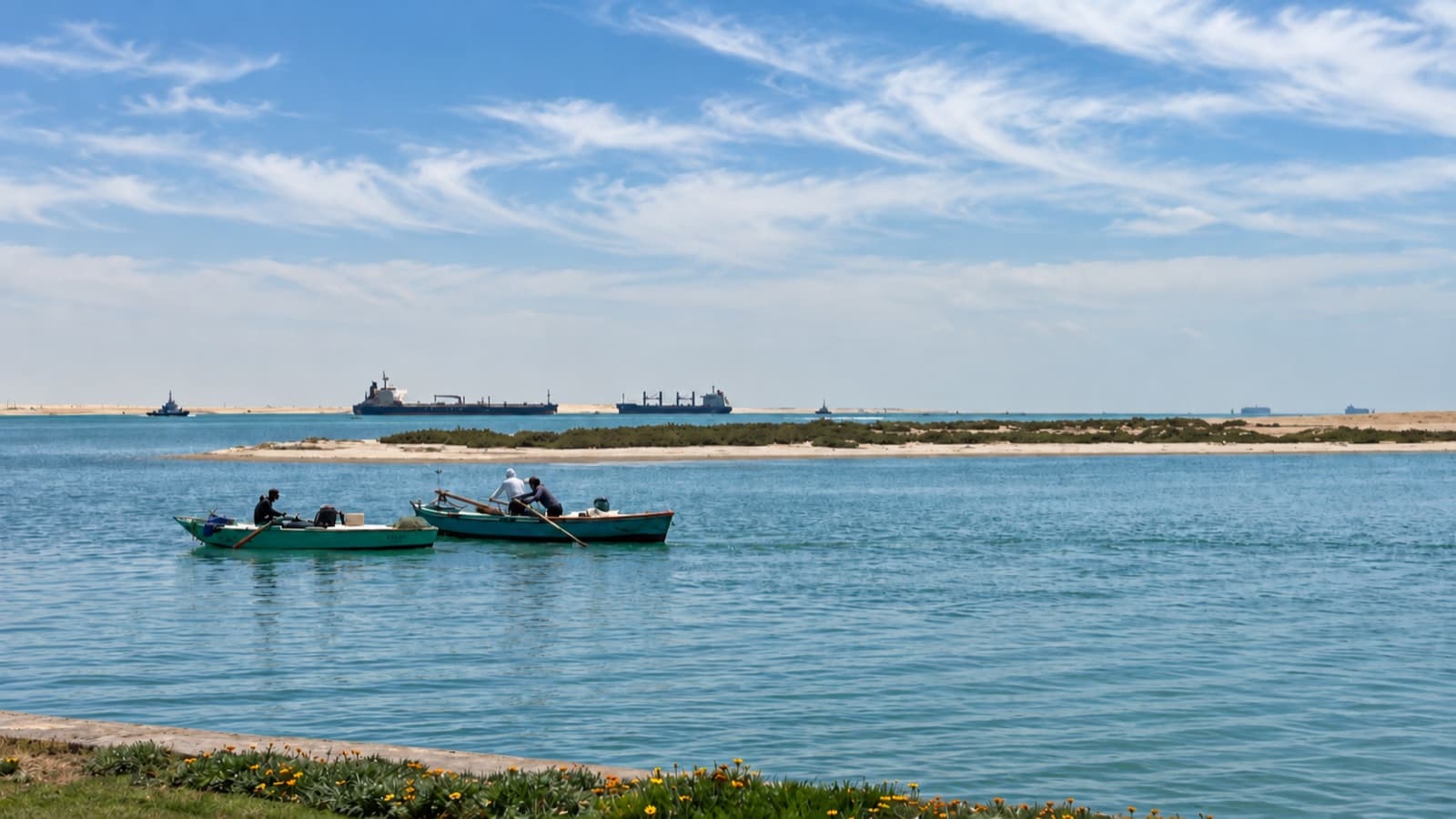
The region sees very few tourists, which means you are not navigating the petty crime and hustle culture that can accompany high-traffic tourist destinations. There is no tourist-targeting infrastructure because there are almost no tourists. What there is: a quiet canal-side city, families, cafes, a university, and the constant backdrop of container ships moving through one of the world's great engineering achievements.
How Ancient Reset Handles Safety
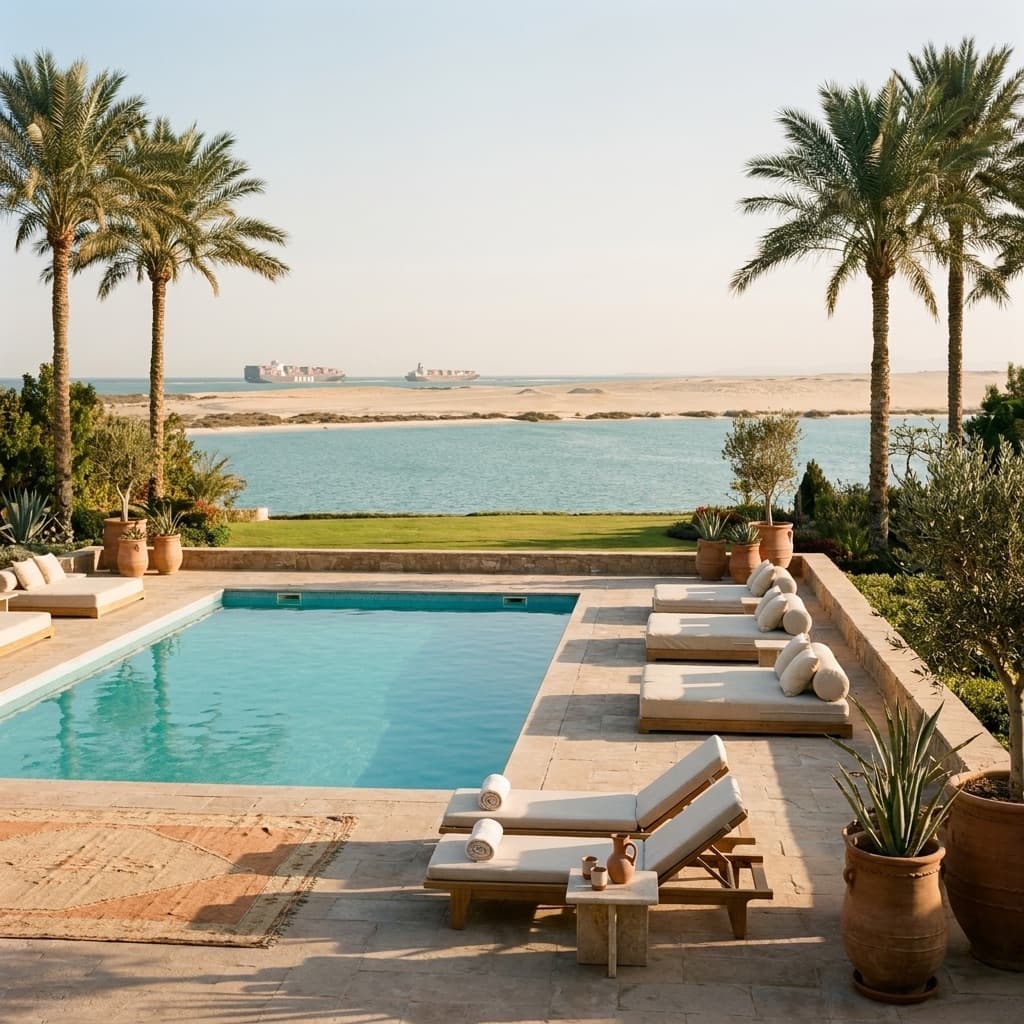
Our retreat operates on a private, gated family estate on the western bank of the Suez Canal. Safety was not an afterthought in the design. It is woven into the structure of the experience.
The property is enclosed and access-controlled. Staff are locally hired, vetted, and known to the family. The maximum guest count is seven per cohort, which means the founder (that is me) is present and accessible on property at all times during every program.
Cultural excursions, whether to Cairo, the pyramids, or local sites, are conducted with private transportation and an escort who knows the area. We do not send guests out to navigate unfamiliar terrain alone. Medical access is planned in advance: Ismailia has multiple hospitals, and our team maintains contacts with English-speaking physicians. Communication infrastructure, including reliable cellular and internet service, is in place throughout the property.
None of this is a response to danger. It is a response to the reasonable expectation that someone spending $7,500 on a week-long retreat should not have to think about logistics or safety at all. The point of the program is rest, stillness, and reset. That only works if the environment feels genuinely secure.
If you want to understand more about what the retreat involves, the homepage covers the full program. If you are considering joining a future cohort, get in touch and we will help you find the right cohort.
Common Misconceptions vs. Current Reality
The Egypt that exists in many Western travelers' mental models is about a decade out of date. Here is what has changed.
Post-2011 instability is over. The revolution and its aftermath dominated international coverage for several years. Egypt has been under stable governance since 2014. The political situation is not a topic of daily uncertainty the way it was between 2011 and 2013. You may have opinions about Egyptian politics, but instability is not the current condition.
The Sinai insurgency has been largely contained. The military campaign in North Sinai, which peaked between 2015 and 2018, has significantly reduced militant activity in the region. South Sinai resort towns like Sharm el-Sheikh have operated normally throughout. The North Sinai "Do Not Travel" designation reflects ongoing caution, not active conflict in tourist areas.
Infrastructure has improved materially since 2020. The Grand Egyptian Museum near Giza, one of the largest archaeological museums in the world, opened to visitors. Road networks between major cities have been expanded. The new Administrative Capital east of Cairo is operational. Egypt's tourism infrastructure is not what it was even five years ago.
Nineteen million tourists visited in 2025. This is the single most important data point. If Egypt were as dangerous as the outdated perception suggests, 19 million people would not have shown up. Tourism at this scale requires functional safety infrastructure, and Egypt has it.
Regional conflict has not spilled over. Despite tensions elsewhere in the Middle East, Egypt has maintained its borders, its diplomatic relationships, and its internal security. The country is not involved in any active regional conflict.
Frequently Asked Questions
Is Egypt safe to travel in 2026?
Yes, for the areas where tourists travel. The U.S. State Department rates Egypt at Level 2 (Exercise Increased Caution), the same level as France, Germany, and Italy. Egypt welcomed a record 19 million international tourists in 2025. The areas to avoid, primarily Northern Sinai and the Western Desert border region, are far from any tourist destination.
Is Egypt safe for tourists?
Egypt's major tourist areas, including Cairo, Luxor, Aswan, the Red Sea coast, and Alexandria, have well-established security infrastructure and low rates of violent crime against visitors. Tourist police are present at major sites. Standard travel precautions apply: secure valuables, use reputable transport, and avoid political demonstrations.
Is Egypt safe for solo female travelers?
Solo female travel in Egypt is doable but requires awareness. Street harassment exists in large cities, though it has improved with enforcement. Practical measures help significantly: dress modestly in public, use ride-hailing apps, book hotels with 24-hour desks, and consider a local guide for city exploration. Organized tours, resort areas, and structured travel settings offer a more comfortable experience.
Is Egypt safe for luxury travel?
Luxury travel in Egypt carries the lowest risk profile of any travel style. Private transport, vetted properties, professional guides, and pre-arranged logistics remove most of the variables that create risk for independent travelers. High-end hotels, Nile cruises, and retreat properties like Ancient Reset on the Suez Canal operate with their own security protocols and controlled access.
What parts of Egypt should tourists avoid?
All four major Western governments (US, UK, Canada, Australia) advise against travel to Northern Sinai and the area within 20km of the Egypt-Libya border. The UK FCDO also advises against all but essential travel to parts of the South Sinai interior and areas of Ismailiyah Governorate east of the Suez Canal. These areas are far from standard tourist routes.
Is the Suez Canal area safe to visit?
The western bank of the Suez Canal, including the city of Ismailia, is a low-crime residential area with continuous Suez Canal Authority security. The UK FCDO restriction on Ismailiyah Governorate applies specifically to areas east of the canal, not the western bank where the city center and most residential areas are located.
How many tourists visited Egypt in 2025?
Egypt welcomed a record 19 million international tourists in 2025, a 21% increase over the previous year. This significantly outperformed the global average tourism growth rate of approximately 5%. Tourism officials project a further 5 to 7% increase in visitor numbers for 2026.
Egypt is not uniformly safe, and no honest assessment would claim otherwise. But the Egypt that 19 million tourists visited last year, the Egypt of the Nile Valley, the Red Sea, Cairo, and the canal cities, is a functioning, secure destination with a risk profile comparable to most of Southern Europe.
The question is not really whether Egypt is safe. It is whether you have accurate information about where the risks are and how your travel style affects your exposure to them.
If you have been considering a trip and this post has helped clarify the picture, that is enough. And if the idea of a week of stillness on the Suez Canal sounds like the right version of Egypt for you, you can get in touch and we will help you find the right cohort.